

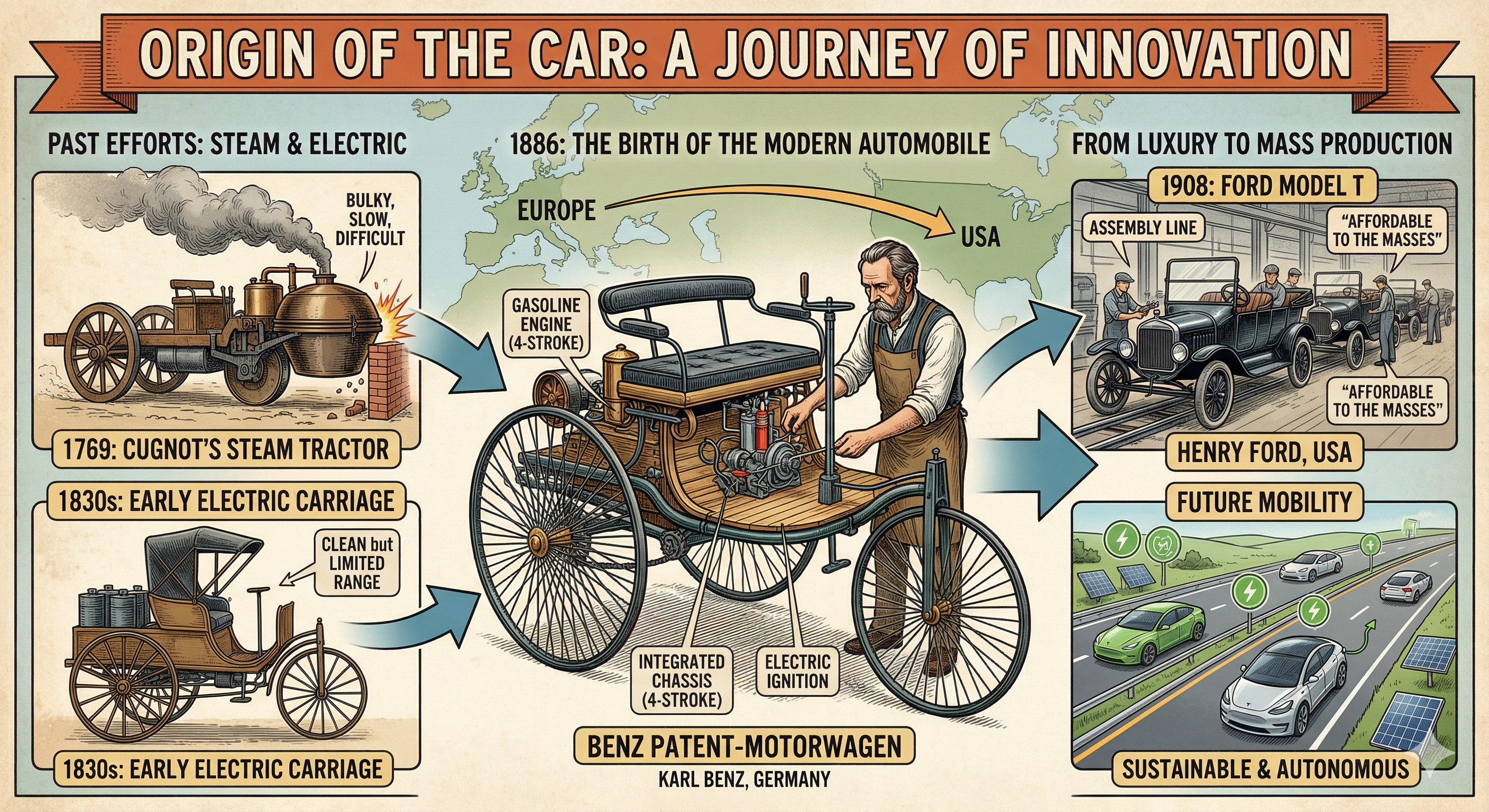
Image generated by AI (Google Gemini)
Origin of the Car: From Horses to Horseless
The automobile did not have a single inventor but was a culmination of innovations that transformed society over a century. Here is an article on its origin and development in English, followed by a detailed illustration.
******************************************************************************
The Dawn of the Horseless Carriage
For centuries, human transportation relied on animal power, primarily horses. The dream of a self-propelled vehicle, a “horseless carriage,” existed long before it became reality. The early attempts were fueled not by gasoline, but by steam and, later, electricity.
The First Steam-Powered Efforts
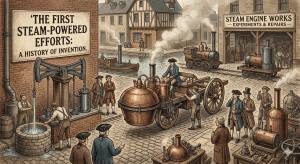
The very first step toward the automobile is often credited to French inventor Nicolas-Joseph Cugnot, who built a massive, three-wheeled steam-powered military tractor in 1769. While it moved, it was slow, heavy, and difficult to steer, ultimately crashing into a wall. Throughout the 19th century, numerous inventors across Europe and America created steam wagons and carriages, which were used for public transport but faced heavy restrictions due to their size, noise, and potential to frighten horses.
The Rise of Electric Vehicles
Electric vehicles also had an early start. In the 1830s, inventors like Robert Anderson of Scotland developed primitive electric carriages. By the turn of the 20th century, electric cars were incredibly popular in cities. They were quiet, did not emit smelly fumes, and were easy to operate, especially when compared to the cumbersome process of starting a gasoline engine. However, they were held back by their short range and a lack of charging infrastructure.
The Breakthrough: The Internal Combustion Engine
The modern automobile, as we know it, came to life with the perfect application of the internal combustion engine.
Karl Benz and the First Practical Car

While many engineers were working on internal combustion, the man most widely recognized as the inventor of the first practical, gasoline-powered automobile is the German engineer Karl Benz. On January 29, 1886, Benz received a patent for his Benz Patent-Motorwagen, a three-wheeled vehicle designed from the ground up, not merely a carriage with an engine. It featured a single-cylinder, four-stroke engine, a chassis, a differential, and electric ignition.
Benz’s creation was innovative, but it was his wife, Bertha Benz, who proved its practicality. In 1888, without her husband’s knowledge, she took their two teenage sons on the world’s first long-distance automobile journey, driving over 100 kilometers (60 miles). Her trip not only tested the vehicle’s durability but also demonstrated to the public that this invention was a viable method of
transportation.
 From Luxury to Mass Production
Following Benz’s success, dozens of manufacturers emerged, but automobiles remained a expensive novelty for the wealthy until Henry Ford revolutionized the industry.
The Ford Model T and the Assembly Line
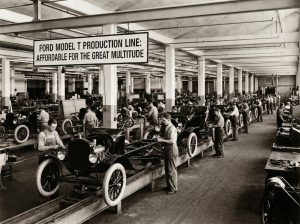
In 1908, Ford introduced the Model T, a car designed to be robust, simple to repair, and, above all, affordable for the average person. To achieve this, Ford implemented the moving assembly line in 1913. This innovation dramatically reduced the time and cost to manufacture each car, making the Model T affordable to the masses. The “car for the great multitude” changed the face of America and the world, giving unprecedented freedom and mobility to ordinary people.
Conclusion
The origin of the car is a story of continuous innovation, from the heavy steam tractors to the elegant Benz Motorwagen and the mass-produced Model T. It is a journey that continues today, moving toward electric and autonomous vehicles, as we once again redefine the future of mobility.
